
In preparation for my Scotland trip, I started reading How the Scots Invented the Modern World: The True Story of How Western Europe’s Poorest Nation Created Our World and Everything in It. Most would assume I am heading over for the scotch, the landscapes, the historical sites, and the scotch again. They would be right. But scotch does not need homework. It is experiential; I will learn it the old-fashioned way, talking to the people who make it. The book is for history beyond the battles: real smart Scots who devoted their lives to a passion, an obsession. Keep in mind, the whole thing is a field trip, not an assignment.
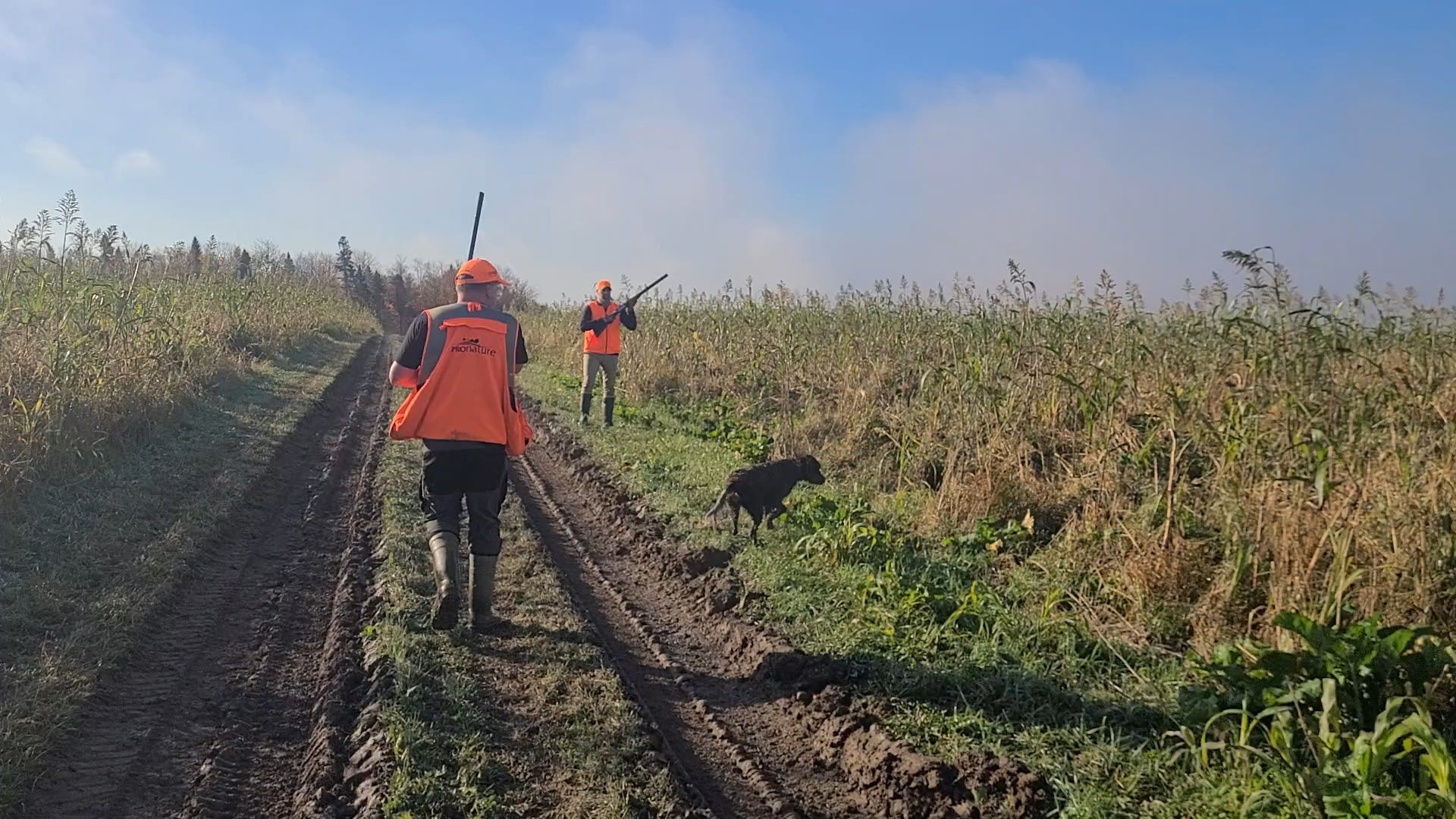
I also realized that Scotland developed another thing I appreciate in life: hunting with dogs. I have been hunting pheasant for almost twenty years now, and somewhere along the way that got our family into pointing dogs: a Picardy Spaniel, one of France’s oldest pointing breeds.
Scotland bred its own pointer, the Gordon Setter, in the late 1700s to hunt grouse on the open uplands. The hunting dog finds the bird and freezes on point. The hunter reads the dog and walks up behind. The dog could catch the bird on its own, of course. But that would mean failing at its role. What keeps the dog on point is inherited restraint. Imagine that restraint: a predator convinced, over thousands of generations, that the slow animal behind it, the one that does all the talking, is instrumental. Strangest of all, the belief is true. The hunter, whatever he tells you, can rarely find a hiding bird on his own. I speak from experience.
Then the Victorians “improved” the hunt. Guns became faster to reload, and the aristocracy turned the hunt into a social event. Hired men walked through the brush in a long line, making noise, pushing the birds toward a row of waiting shooters. The gentlemen stood in their assigned spots and shot what flew over. Nobody needed the finding anymore, and the pointers were replaced by retrievers, dogs whose task begins only after the shot. Marksmanship became the sport and the day’s count became the score. You only get record numbers when the birds are being delivered to you. Where I grew up, a schoolyard dispute was settled one against one, never a gang against one. The gentlemen dropped that rule and called it progress.
One of the worst sport hunting stories I ever heard went around Montreal business circles while I worked in them. Jean-Alain Bisaillon, the Marché Central promoter at the centre of the massive fraud file at the expense of a congregation of nuns, hunted caribou in the Grand Nord. The story that circulated was that a helicopter flew him to the big herds and, from up above, harassed the poor animals into exhaustion, running them along a river or straight into it. The hunter carried an automatic rifle, I presume. No walking, no finding, no dog. Ultimately, amidst the allegations, he took his own life at a skeet club in 2002, between clay pigeons being pulled for him on command. Seems like every target he ever hit was delivered to him.
Being extremely good at shooting does not make one a hunter. If you cannot find your next meal, all the medals in the world will not serve what the skill is actually for. The finding and the shooting are not the same skill.
Being extremely good at math does not necessarily make you a great mathematician either. Around 1900, uncaught errors in mathematical proofs were piling up; even the brightest were publishing work that later cracked under scrutiny. David Hilbert, a German mathematician, came up with a new approach to checking proofs, and he set out to write the rules down. Now, with his explicit rules, anyone could validate a proof, step by step, the way a layman checks basic calculations. Gödel, a fellow mathematician, later demonstrated the limits of that approach, but I digress.
The approach was fruitful, and mathematics ran on that rulebook for a century. But a proof that anyone can check is a proof a computer can be programmed to check as well, at faster and faster iterations.
By 2026, multiple headlines were declaring that artificial intelligence had taught itself past the mathematicians. Most of us have no way to check these claims: the AI companies are relentless at marketing, and every solved problem doubles as another press release. And “taught itself” hides the actual teachers. AI models learned from centuries of published proofs and even from research posted just weeks ago. No one is crediting the minds behind any of it, dead or living, as if the models invented everything. AI learned from their work, and now mathematicians feel they have to get out of the way.
The AI companies went after math first for an obvious reason: a mathematical answer can be validated outright. It is correct or incorrect, no ambiguity. In medicine or law, a finding can only be supported, more or less strongly; it is rarely settled outright. Math is attractive to the model builders because they have the rulebook.
Hilbert’s rules covered the checking. They never touched the other question: which problem actually deserves ten years of one’s life, which matters and which is just a puzzle. A pot shatters on the kitchen floor: do you glue it back together? A Ming vase, most certainly. A mason jar, you sweep and move on. Same glue, same skill, and nothing in the gluing manual tells you which pot deserves it. Nobody has ever managed to write that rulebook, or map the path to the right question. Hilbert wrote the marksman’s instructions; nobody wrote the hunter’s map. Solving was the shooting. Choosing was the finding.
Now imagine the math you would need to figure out, up to the millionth decimal, how many pints of beer I consumed yesterday at the brewery. Assume a pint is exactly 16 ounces, as the benchmark. There could be beer droplets in the air I consumed without knowing, some beer left at the bottom and on the side of the glass. Some of it could have come out of someone’s sneeze, or even mine. Talk about granularity. An AI would take the problem head-on. It could burn a data centre’s afternoon counting droplets. While doing that, it would do nothing else. Nothing inside a procedure knows how to say stop, this does not matter. Or I could use my judgment and say: I had about two pints, which I enjoyed greatly. The two answers differ by six decimal places and a whole lot of electricity.
The mathematicians have their own intuition too.
This past summer, an AI knocked over a conjecture that had stood since 1939 with an equation short enough to fit on a Post-it note. At the mathematicians’ world congress in Philadelphia, one researcher now opens his talks with a slide on the five stages of grief, which I assume is a fair indication of the mood in the profession. The fear seems to run all the way down: graduate students told reporters they pay for AI subscriptions just to keep up.
Grief implies something was lost. But are they grieving the right thing?
Let us look at math prizes. Someone had to decide which problems actually deserved one. Prize problems are picked by committees, and the profession has honoured and accepted those choices as the gold standard. And there are real incentives attached: prize money, tenure, a career path. The incentives all point the same way: chase the problems hiring committees respect, publish what the journals already cite. An apprentice mathematician does not necessarily need to ask what matters. Mathematicians let the committees do much of the choosing long before AI started doing the solving.
Physics shows what that can look like. For a generation, the surest path to a career was string theory, and the brightest went down that corridor. I have heard the mathematical physicist Eric Weinstein make the case, on more than one podcast, that string theory was a dead end and that the people who said so early paid with their careers. Nature did not point everyone down the corridor; the job market did. I should note that string theory has not been pronounced dead yet. I have a weird feeling it is. What do I know?
The book I mentioned earlier is full of them: Scottish geniuses who questioned what everyone knew, were sidelined for it, and often got their recognition only after they died. David Hume, whose philosophy is still taught wherever philosophy is taught, was passed over for professorships at Edinburgh and Glasgow. James Hutton, the father of modern geology, could look at a layered stone in a farm field and see a question. He spent years studying rocks, erosion and geological layers, eventually concluding that the Earth was unimaginably older than the six thousand years the Bible had implied. The gatekeepers of biblical chronology, blindly defending that count, rejected the finding. The discoveries that changed history came, again and again, from people their own era had written off. The experts of the day called them quacks, and they almost had to: accepting the discovery meant rewriting the dogma that made them experts.
Which brings us to a character who shows up whenever a powerful new tool arrives: the technology evangelist. The industry itself uses the word without irony. You have heard the saying about the one with a hammer, how everything looks like a nail. The evangelist is that person, but with an “improved” version: electronic hammer in hand, goggles that find nails. The tool comes first; the problems get located afterward.
“Solve math, solve everything,” reads the slogan of one AI-for-math startup I came across. But look at which math the models solve: again, the famous prize problems, targets mathematicians picked decades ago. The hammer goes where humans already pointed it, so it inherits every human blind spot. Hume, for one, did the opposite: he followed his arguments to conclusions his era punished him for. Originality, even the tool-improving kind, rarely offers short-term rewards.
It would be convenient to blame the money, but what I learned reading about the brilliant Scots ruined that theory. James Watt had institutional support from the University of Glasgow, and eventually incentives to the teeth: patents and a rich business partner. But look at the order. He was repairing the university’s model steam engine when he realized how much heat it wasted. Sounds like a sensible problem to solve, except almost nobody else saw the waste as much of a problem. Coal in Scotland was dirt cheap. It was akin to asking Einstein to repair your thirty-year-old fridge. Why glue an old broken mason jar? Little reward for the added efficiency. No customer demanded it. Watt followed the waste anyway, and his answer eventually became the engine that powered the Industrial Revolution. Incentives will give you a budget, but they will rarely take you off the beaten path. Judgment will.
Watt went outside the box on a tight budget and was later credited as the father of the Industrial Revolution, after pursuing what at the time looked like a low-return problem. The “heretics” Hume and Hutton did the same, in a poor nation with few chairs to win and no prizes telling its thinkers what mattered. Their obsessions ran on their own fuel because there was nothing else to run on. That may be the real answer to how Western Europe’s poorest nation invented the modern world. I read that from New Brunswick, a province economists tend to file under poor. It hits the right note. It gives me hope that ingenuity is still the right path.
So let us get back to the Philadelphia math congress, now with my field trip in mind. From what I read about the event, I sense a prevailing mood that AI is making mathematicians feel outdated. I think they have it backwards. AI took the solving. Mathematicians had long handed off the mechanical parts of it, the calculating and the checking; AI just took more of the shooting. Much of the choosing had been handed over long ago, to the committees. The corridor full of string theorists shows how that went.
What nobody took is the “finding”: knowing which question is worth ten years of a life. In this hunt, the mathematicians are the dog. They should now treat AI as their marksman, the one that takes the shot.
And the AI companies selling these tools are running the oldest domestication program there is: convincing the finder that the shooter is the essential partner. The message is everywhere: AI will beat you at your own research any day now; you are hurting yourself if you do not pay for the subscription; start working through your five stages of grief. All this for a death nobody has confirmed. They run a good obedience school.
The finders have begun saying so themselves. Two dozen Fields medalists, including Terence Tao, signed a declaration saying problem-solving was only a proxy, and that the companies’ goals were misaligned with theirs. In this story, the dog is starting to notice what the obedience school is for.
Learning to defer to a partner’s skill is one of the oldest arrangements we have. That partnership has fed hunters and dogs for ten thousand years. In this social contract, the dog never has to worry about its next meal, and the hunter has to keep learning and updating the way he works with the dog. The partnership is not the danger. The danger is convincing the finder that the hunt can do without it. And that idea is not coming from the marksman; it comes from the technology evangelists who genuinely believe the guided hunt is the only path (for a fee).
The difference is skin in the game. The hunter walks the field with the dog, eats the same weather, goes home hungry on the same empty days. The evangelist sells the gun and eats either way, as long as you remain a believer and a subscriber.
People may think I am a good pheasant hunter because they have seen my hunting pictures. Without my pointer, I would starve.
You do not train a dog to hunt. Pointing is innate. You train the dog to work with a hunter. A useless hunter is the one who does not know how to work with a dog that has all the incentive in the world to find him that bird.
The dog does not stop pointing because the gun improved.