
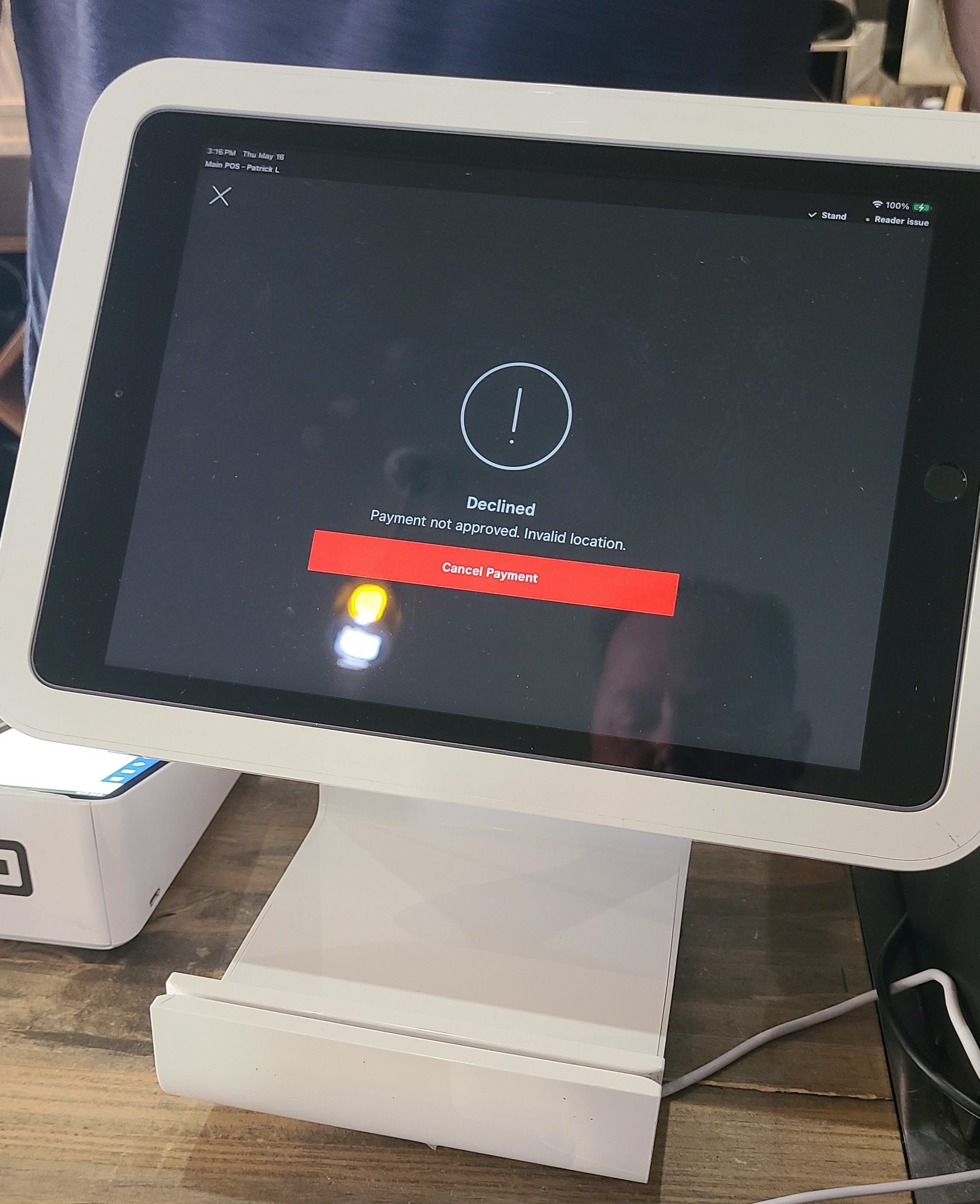
In May 2024, our payment terminals started refusing transactions at the brewery.
I called Square. The person on the phone was polite. They walked me through the steps. The people who have been there know the drill: reset the terminal, check the connection, try again.
I tried again, and again. Same problem.
Word on the street, or in the Taproom, was that other businesses in Edmundston were having the same problem. The restaurant down the street. The coffee shop around the corner. A system failure, I assumed. I checked the Square status page. Dashboard showed all green. I guess Edmundston was just a margin of error.
We were all calling Square. We were all getting the same script. Reset. Reconnect. Try again. Nobody could tell us why. My day had just switched to debug mode.
I was helpless. Cash was king at one point. Then plastic made every business dependent on a third party to complete the most basic act of commerce. Most customers were not going to the ATM. I could not properly serve customers until this was fixed. Meanwhile, every Square user in town was calling customer service, and they could not fix the problem either. Felt like a quagmire was developing.
Then a pattern emerged, I figured. The businesses having the problem were all along the Canada–US border. Edmundston sits right on it. That is the kind of pattern you would want to know if you were tasked with troubleshooting at Square.
I called Square again, armed with what I had found. The person on the phone had no procedure for receiving a diagnosis from a customer. They had a checklist. Screenshot of the error. Run a test payment. Try another network. The checklist had a terminal flaw: no slot for my problem. It was designed for a broken terminal, not a geographic mislocation affecting many businesses along an international border. The call ended the way the others had. The problem was my fault. So they thought.
After a couple of weeks I went to Twitter. I described the problem publicly. That changed the dynamic completely. Within minutes, a direct message from Square. The escalation was triggered. Suddenly I was in contact with an engineer named Jack who had access to the system and the authority to look at what was actually happening.
He was not following a script. He could hear.
I told Jack my theory. He confirmed it. The terminals along the border were reading their location as the United States. They would not process Canadian transactions because, as far as the software was concerned, they were not in Canada.
Jack overrode my settings manually. Bienvenue au Canada. The problem recurred a week later while I was in Europe. A system update reverted the manual bypass. Jack fixed it again within minutes, then a permanent software update rolled on the next Wednesday. Done. The whole thing took about three weeks from the first escalation to the final fix.
With the help of hindsight, I later came up with a theory about what could have triggered the location issue. My hamster brain tends to work overtime with stuff like that.
The new Madawaska–Edmundston International Bridge opened to traffic on June 6, 2024. The new bridge replaced a crossing that had stood since 1921 on a new axis, just meters from the original.
I do not know how Square locates its terminals. But my problem happened just the month before, in May. This one time, for me, correlation was causation. I was satisfied. I could be wrong. Most customers with theories are, I assume.
Multiple businesses were calling in through the proper channel. The channel could process a complaint. It could not carry an insight. But Jack could.
There is always a Jack inside those large organizations. The path to him exists. It is not available from the outside. Most systems are designed to make sure you never reach him. At one point, I was a Jack when my parents had printer issues, and they had my phone number. I quickly figured out I was not customer service material. I digress.
Twitter forced Square’s hand. It did not create the path to Jack. It made the failure visible enough that Square activated it.
And Square was a company with a phone number.
There was a time when having a problem with something you bought meant going back to where you bought it. Someone behind the counter heard you and acted, or told you plainly they could not. The distance between you and the person who could help was a few feet.
You want to tell our brewer personally that you enjoy our pilsner? Come to our taproom. We have a counter for that. Not a difficult task.
For large companies, the hotline replaced the counter. The phone tree replaced the hotline. The chatbot replaced the phone tree. Each step cost less to run. Each step removed a person who could read what you were actually saying.
The endpoint is not worse service. It is the absence of it, all designed to look like its presence.
Every interaction the institution eliminated saved money. A dollar removed from expense is a dollar moved to profit. What was lost is now invisible.
The person with the problem can no longer reach the person who can fix it. The institution did not stop listening on purpose. It stopped because listening gets harder, fast, when a business grows. No big time executive gets rewarded or promoted for arguing that customer service should grow at the same scale as the business.
The product stops improving because the feedback that would improve it no longer arrives, unless it pops up in the numbers (you know, big data). The customer stops trusting because trust is built on being heard. The cost compounds quietly. Not in any single interaction. In the aggregate. In the product that drifts further from the people using it while the dashboard says everything is fine.
Choosing the dead ear is not free. It is just not a cost anyone is tracking.
But that was a payment terminal problem. Imagine when you don’t know Jack.
Now consider the business that runs on a platform it does not own. Your customers find you on it. Your revenue depends on it. The way you reach your customers runs through someone else’s system, on their terms. Not negotiable.
The platform suspends your account. You look for someone to call. There is no one to call.
Billions of users. No phone number. Try finding one for Facebook.
Unless you are visible enough to force one.
Even the companies trying to get it right hit the same wall.
You pay for a tool. You use it daily. Something goes wrong. You write a detailed report through the usual channel. Days pass. Sometimes more. A reply arrives. It is templated. It addresses a version of your problem that is not quite your problem. You reply with the specifics again. Silence. I know. It was my recent experience with Anthropic (Claude.ai).
The institution did not ignore you. It processed you. Processing and hearing are not the same thing. Unless you are part of a trend on a dashboard, you are a rounding error.
The bigger the company, the larger the market capitalization, the more users it serves, the less likely it is that you can reach a person who can act on what you are telling them.
Market capitalization and reachability run in opposite directions.
The store counter had a feedback loop. The person behind it could hear you, read what you meant, and act on it or walk it to someone who could. Every step that replaced the counter was designed to handle more interactions. Volume and quality are not the same thing. A system optimized for volume processes ten thousand complaints identically. It hears none of them.
The company that made itself unreachable did not just save money. It lost the ability to hear the thing that would have told it what to fix next.
That is not the efficiency that technology promised. The consumer lost on that equation.
Jack could hear. The system made it difficult for me to reach him. The real cost is not what I went through to get there. It is that they will never have enough of him. When you scale by removing the person who listens, you lose the conditions that produce people who can.