
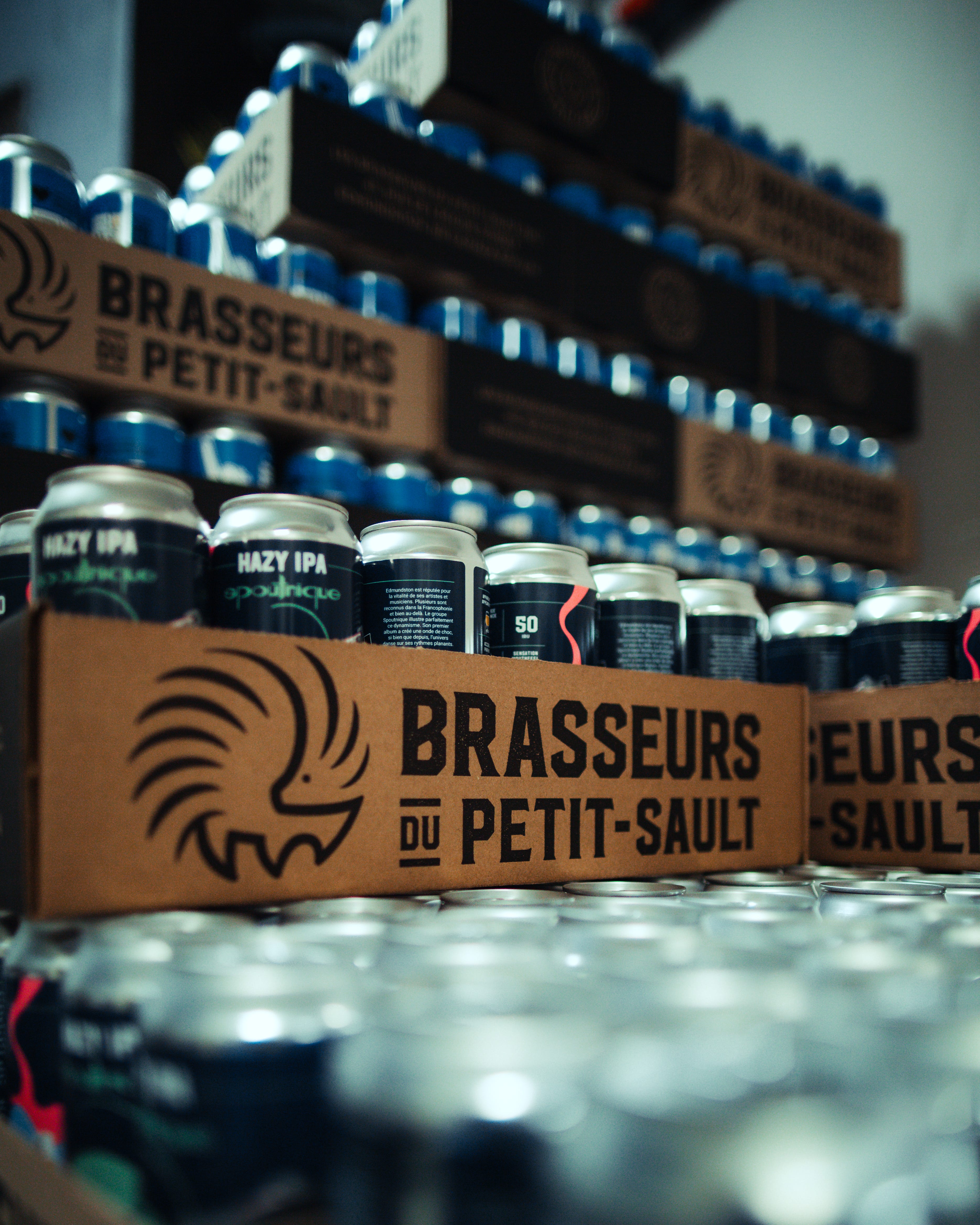
Around ten years ago, a group of craft alcohol producers in New Brunswick got together to find a common voice. We were trying to define what craft meant, mainly to have something to say to the regulator and the provincial liquor monopoly. Big beer had the shelf, the taps, their ears. We were fighting for inches. The people in that room had simply taken a turn making something they loved, at considerable personal cost, bound by a simple thing: making good beer and good alcohol in their province. Nobody was getting rich fast.
In the middle of one meeting, someone asked a simple question: if a brewer used malt concentrate instead of mashing grain, would their beer still be considered craft? It was exactly the kind of question the group had assembled to answer. The room reacted as if a bad word had been spoken. Not an argument. A reflex. The question had landed before anyone had evaluated it.
The reaction made some sense. Elsewhere in the province, some distiller licence holders were buying industrially produced neutral grain spirit, adding botanicals, and calling the result craft alcohol products. That fight was real. The line was genuinely under pressure. But in that atmosphere, the room could no longer tell the difference between a producer gaming a definition and a brewer asking an honest question.
What nobody mentioned: some extract beers have won competitions. Blind taste tests have fooled experienced judges. The quality gap that once justified the stigma had closed. The room was not arguing about quality. It was arguing about identity. About what the group was trying to be, and who got to belong to it. The room never found out, because the room never asked.
I saw the same mechanism more recently, in a university in Cameroon, when I mentioned ChatGPT to a room of trainers. Immediate. I could read it in their faces. Not curiosity. The word had landed before the question had, another bad word in another room. This could have been any classroom, anywhere.
This alarm also made sense. A student has to write a book report. The student hands it to an AI tool, runs it through an obfuscation tool, submits it. The assignment was designed to build something. That process has been bypassed entirely.
But the programme we were developing was for women entrepreneurs. Say one of them needs to understand a concept she cannot grasp. She finds a book, reads an article. She uses AI to explain the passages that stop her. She is not skipping the reading. She is doing more of it. The tool is extending her reach, not replacing her effort.
Same tool. Opposite relationship to the work.
The institution could not tell the difference. Its response was the same either way.
In the eighties, a teacher could usually tell when a student had copied from an encyclopedia. A ten-year-old does not write like that. I know because I tried. The signal was readable. The receptor still worked. Today the output looks the same whether the work was done or bypassed. The tool closed the gap the teacher used to read through.
What has changed is not the temptation. What has changed is the capacity to read what is actually in front of you.
The craft alcohol story ended quietly. A question was never asked and nobody noticed. The Cameroon story has not ended. Those trainers went back to their classrooms. I may have shifted something for some of them. For the others, I cannot say.
Every institution eventually does the same thing. It takes the judgment of its best people, writes it down, and runs the rule forward. The rule is cheaper than the original. It is also always a little wrong.
What AI replaces is not jobs. What AI replaces is the rule that stood in for judgment. The procedure that was already standing in for something else. The judgment was already gone. AI just made the procedure cheaper to run.
Education systems penalize students for using AI because they cannot tell the difference between use that bypasses learning and use that deepens it. Corporations mandate AI adoption without distinguishing procedural tasks from those that require judgment. Regulators write policy that addresses what they imagine AI does, not what it actually does. They call it ‘responsible AI.’ Human in the loop is the reassuring phrase. The judgment has left the room. The language remains.
This is not a virus model. There is no external pathogen. The institution’s own immune system has turned against itself. It cannot distinguish between a threat and native capacity. The receptors still fire. They fire at everything.
Institutions do not lose judgment because they misunderstand the situation. They lose it because the cost of exercising it becomes higher than the cost of running the rule.
A rule does not have a shelf life stamped on it. But ignore it long enough and it stops protecting what it was written to protect.
The problem is not AI. The problem is the kind of work that institutions have already reduced to procedure.
The argument that AI will make most human work obsolete follows the same misreading. It confuses the rule that stood in for judgment with the judgment itself.
AI is extraordinarily good at generating and running rules. If your work was executing it, the ground has shifted. But the rule never created the value. The value came from whoever noticed what the situation actually required, knew when the rule was wrong for this case, and made a call that cost them something if they were wrong. That capacity does not get cheaper when AI arrives. It gets rarer.
I use AI in my own work. It does not tell me what to think. It gives me more surfaces to think against. The meaning comes from my side. The tool amplifies what is already there. If nothing is there, there is nothing to amplify.
If you think writing better prompts will save your job, it might. It will not save your career.
The beer at my brewery is mashed by Michaël. The team around him is part of what you taste. If the person serving you in the taproom makes you feel genuinely happy to be there, the beer tastes better. Not many people account for that. You can analyse every molecule and reproduce the recipe exactly. You will not reproduce any of it.
AI can match the thing. It cannot match the person behind it. For certain things, the person is the value.
The same is true of your grandmother’s cooking.
AI runs on electricity and silicon. It does not metabolize. It does not pay a cost to exist. It does not die.
A system that pays no cost for being wrong has no reason to develop judgment. Judgment emerges from exposure to consequence. The feedback loop requires that something be at stake.
AI has no stake. It cannot have an autoimmune response. It cannot mistake native capacity for a threat because it has no native capacity to protect. The failure mode playing out right now in education, in corporations, in regulatory bodies, belongs entirely to us. AI is the stress that made the condition visible.
The processing gets faster. The judgment gap gets wider. Biology and physics do not negotiate with institutions.
Whether anyone inside those institutions is still reading clearly enough to manage it is a genuine open question.
The trainers in Cameroon are part of that answer.
So is every room that has already decided it knows what the word means.