The articles are everywhere, the podcasts too. Something is coming. Maybe next year. Three years at most. Five, tops. Depending on who you ask and what they are trying to sell you.
The hype is real. The progress is real. But most of what is being sold is still a sales pitch. Especially the ‘G’ in AGI.
Artificial General Intelligence, the version of AI nobody has built yet. A machine that reasons, learns, and solves problems across any domain. On its own. Not just chess, not just code. A brewery. A hospital. Everything.
It is not an ambition. It is a tell.
The definition keeps moving. Every time the machine falls short of General, the people selling it move the goalposts.
Jensen Huang runs Nvidia. His chips power most of the world’s AI. He declared AGI achieved, then admitted in the same conversation that the odds of AI building something like Nvidia are zero. That is not a milestone. That is a marketing claim eating its own tail.
What we call reason can be automated. The machine that beats every grandmaster is not a trick. It is reason at scale. It does not read the game the way a grandmaster does. Millions of positions evaluated per second. In a closed system with fixed rules, computation is sufficient. Judgment is not needed. The machine only needs what is on the board.
Chess, code, medical scans. Within those boundaries, it is often superhuman.
The promise of the ‘G’ is that you open the boxes. The machine reasons across any domain, on its own. Generally.
But reason is still reason. Scale it as far as you like, a machine cannot walk into a room mid-conversation and know they were talking about “it”. For humans, just a faint blush says everything. The machine was not in the room.
Friday evenings, the Petit-Sault taproom gets festive. Conversations overlap. Glasses clink. Music runs underneath. Your brain handles this without effort. You hear the person across the table. Not because the other sounds disappear. Because your brain, in real time, reads what matters and drops the rest. It filters. Not everything gets through.
Last summer my parents drove in from out of town. We sat together in the taproom on a busy Friday.
My father wears a hearing aid. That night, he struggled to follow the conversation. I watched him smile and nod at things he couldn’t quite hear. He had probably turned it down.
Everything came at him at the same volume, like a phone call from someone standing in a crowd. The group at the far end of the bar. The clink of glass behind them. The music. My mother beside him. All of it arriving with the same priority. The brain filters. The hearing aid does not. That was the problem.
Not all misreadings cost the same.
In 2018 and 2019, two Boeing 737 MAX aircraft crashed within five months. 346 people dead. The pilots never had a chance.
Boeing had redesigned the 737 with larger engines set further forward on the wing. It changed how the plane handled. Rather than redesign the airframe, Boeing added a system called MCAS. Boeing gave MCAS one sensor input per flight. The aircraft had a second. Engineers wrote the system to read only one. When that sensor misread the data, MCAS pushed the nose down repeatedly. The pilots fought it. The software’s instructions overrode their judgment.
Observe a first-time flyer on a commercial flight. Every sound registers. Every shudder. Every turn, every drop in altitude, every change in engine pitch. They grip the armrest. They look at the flight attendant’s face for reassurance. Not because the plane is in trouble. Because nothing in memory tells them what is normal. Everything arrives as potential signal because nothing has been filed in memory yet.
The pilots in both crashes were reading the aircraft. Their body, their instruments, their experience. One sensor contradicted all of it. The software was not built to question it.
The first-time flyer has no instrument yet.
I have been tasting our beer for thirteen years. I know when something is off. Not always immediately. Not always in words. But I know.
The midwife who reads a labour room in seconds, the mother’s breathing, posture, skin colour, the rhythm of the contractions, built that reading across hundreds of deliveries. Each one different. Each one adding something that belongs to her and no one else. The emergency room nurse reads triage in a glance. The pilot knows in their seat what the sensor cannot read or misread.
This is judgment. Specific, not general. Accumulated over a lifetime. You paid the cost when wrong. You got the reward when right.
It fails sometimes. The difference is that the person who exercised it faces the consequences, however minimal. No training data does that.
No two people read and sort the same way. That is why you bring different people into the room for each important decision.
The assumption is that the problem is sensors. Not enough data. Not enough inputs. Not enough compute. Scale the machine and you close the gap.
But our advantage was never in receiving more. It was in knowing what to ignore.
Reason computes. Judgment reads and sorts. Insight arrives where experience ends.
Pattern recognition finds what has appeared before. Artificial intelligence does this remarkably well, at superhuman speed, across scales no human can match. Insight is the moment something arrives that experience could not have produced.
Sometimes I taste something I cannot name. Not a deviation. Something new. The palate registers it before any previous experience covers it. It arrives from the body before the mind has caught up.
The midwife who has attended a thousand births still encounters the delivery that feels different before she can say why. The moment of knowing precedes the knowing. The pilot felt it. The instruments confirmed it later.
Can AGI ever have insight? Nobody has shown how. You do not get there by scaling reason. Improvement from data is not the same as improvement from consequence. The machine does not pay when it is wrong. Someone else does.
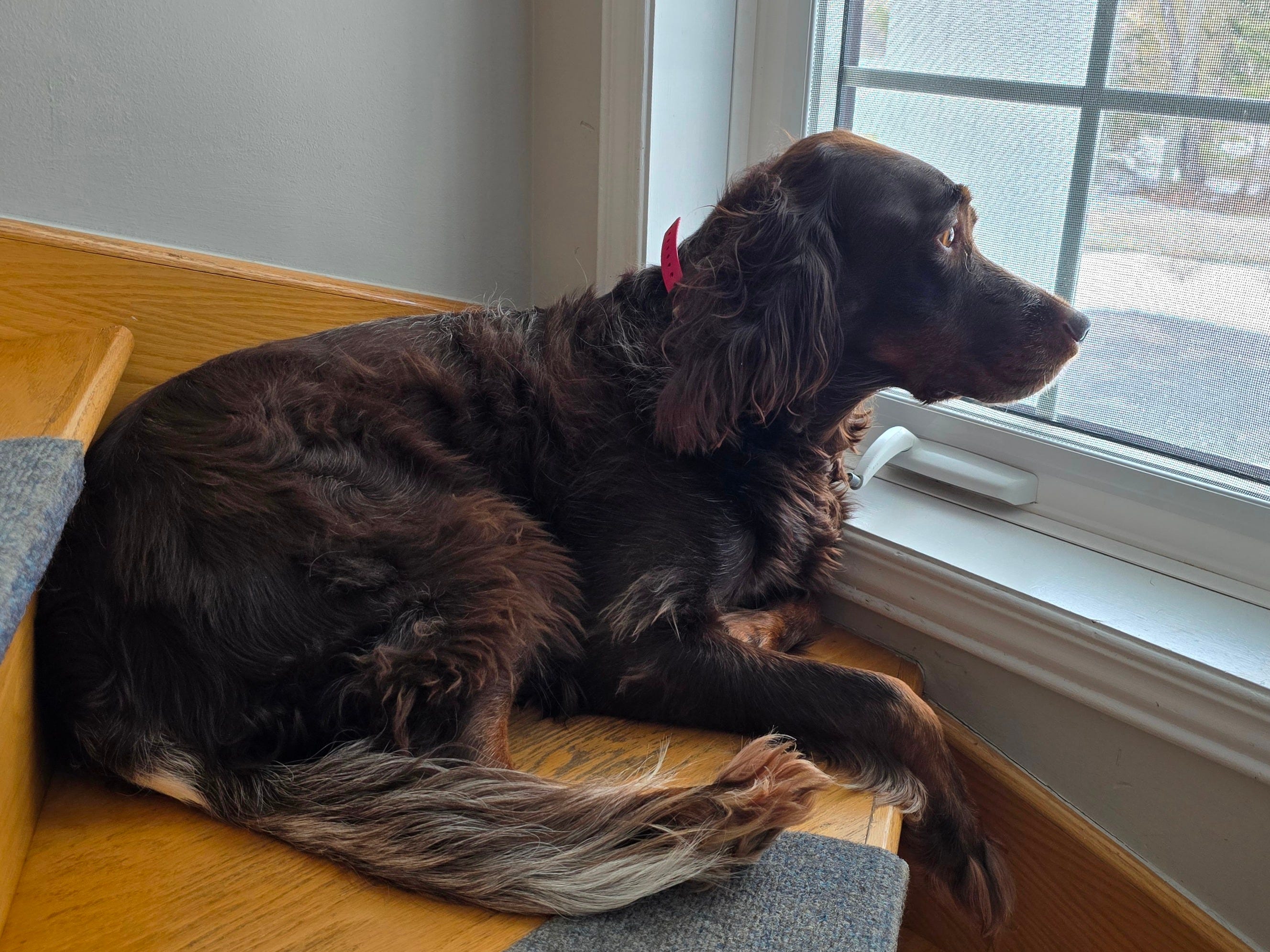
As I write this, my dog is monitoring the front of the house from the window. Intensely. My wife has been away almost a week. She’s driving back from the airport, about 100km away. The dog is waiting.
Now tell me exactly where that sensor is.