
While having a beer with friends some time ago, the daughter of one of us dropped by our table at the brewery, back home from a university break. I knew she was studying business, but I’d never followed up on what concentration she was considering. Accounting and finance was the answer. I couldn’t help telling her my classic dad joke: you know the difference between accountants and financiers? Accountants look backward, financiers look forward. As expected, she gave me the polite half-smile gen z reserves for dad jokes. She was stuck in the present, and she didn’t know it yet.
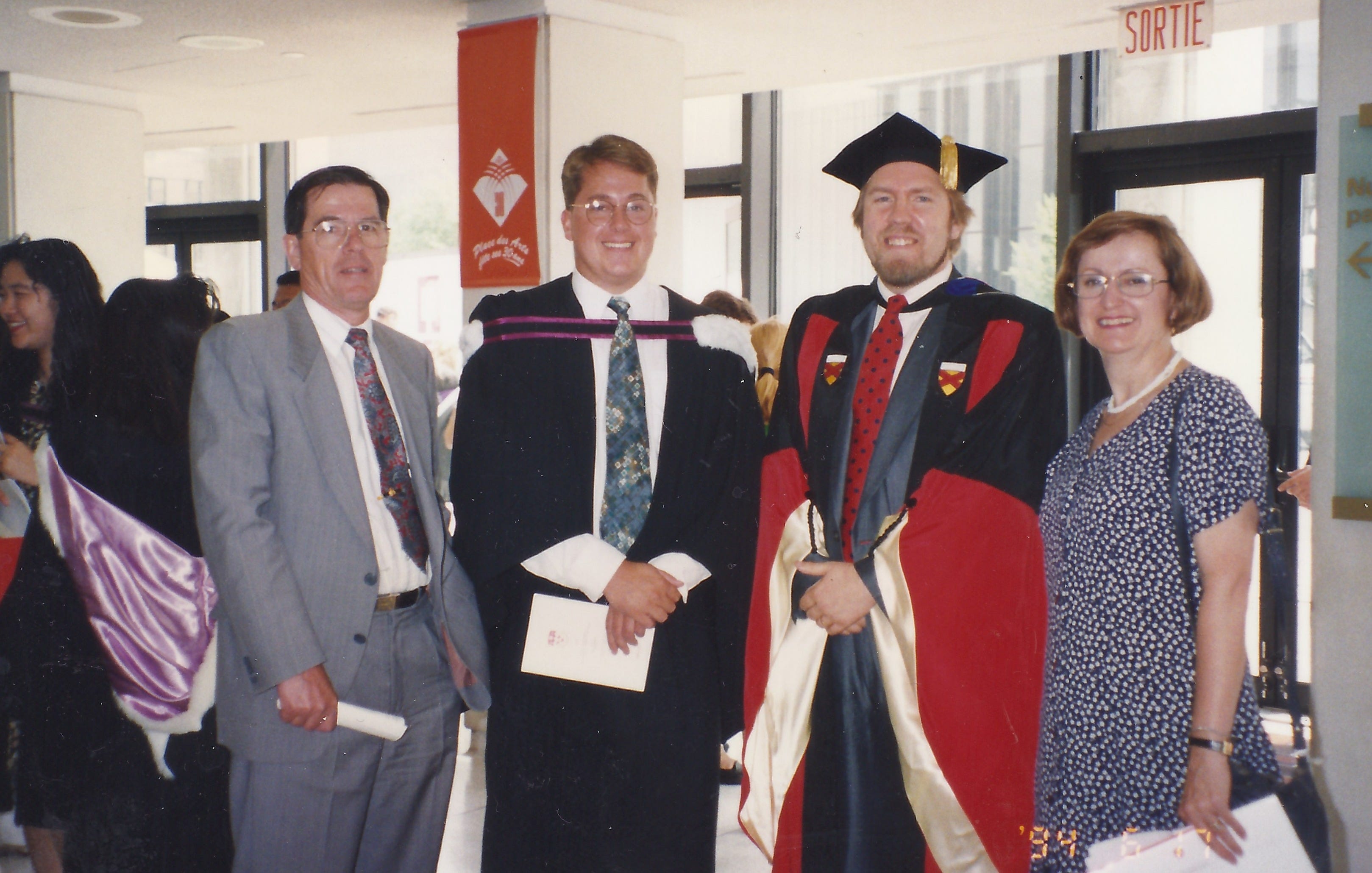
So we got talking. I told her I had an economics and finance concentration from McGill, class of 1994. I told her accounting and finance was a great combo, that whatever she ended up doing, not letting other people count your own money was an important life skill.
Moving on in the conversation, I said something a bit dramatic, not usually my style, but I was on a roll. I told her that most of the advanced finance theories I’d learned in my undergrad years had turned out to describe a world we don’t actually live in: Black-Scholes option pricing, CAPM, portfolio allocation, alpha and beta, and some other financial mumbo-jumbo. Still on the menu, even though the kitchen knows it’s gone bad.
Not wrong inside their assumptions. Just dangerous when you forget the assumptions are there. The Long-Term Capital Management implosion of 1998 was the first big crack, the 2008 crisis was the wider one. The main culprit in both cases was financial modelling built on the normal distribution, using the past as a predictor of the future.
Such severe events were never recorded before. Who could have known. The previous recorder probably said the same thing about the one before that.
Please allow me one more boring joke. I think it adds some context. A physicist, a chemist, and an economist are stranded on a desert island with a single can of food but no way to open it. The physicist suggests using force and gravity to crack it open. The chemist suggests heating it until the pressure bursts the lid. The economist simply says: “Assume we have a can opener.” (Gemini condensed the joke for me. The chain has been running for a long time.)
So where am I going exactly with my histoire de mon oncle? Nowhere fast, I bet you’re thinking. I currently run a brewery, work on a one-off project in Cameroon and Senegal, and write a Substack conveniently named I’m Not an Expert (psstt. this is essay nineteen), on topics including artificial intelligence, organisations, judgment, and so on. Not your usually interesting taproom conversation.
Why I write
What was my trigger for starting writing in January? I turned off the TV. I had questions; nothing existential, not a midlife crisis, but about things I’d been carrying for years without spending adequate time to think them over: capital markets, Bitcoin as a refuge currency, quantum biology, institutional drift. Questions that had been sitting in a backlog while the TV ran, the idiot box they used to call it.
Writing turned out to be a great way to challenge my ideas, find out what I actually thought. Who would’ve thunk?
Last January, I was in Douala, Cameroon, working on an economic development mandate, spending the evenings in the apartment with some free time, and I just started writing what became my first published essay. As I write this, I’m back in Douala. They say fish is good for the brain. Good assumption.
Then came the harder question of whether to keep it private or publish. Taleb, one of my favourite modern thinkers, settled it for me, well, at least in my mind. Publishing is skin in the game, as he would say, and if you’re going to hold a position, put it where it can be challenged, improved, or discredited, because keeping it private is the same as not holding it. Yes, to answer the questions you didn’t think of asking: I sometimes feel bare in front of the room publishing all these essays about my personal experiences.
That’s it, I write for myself. The name of the Substack came naturally: I’m Not an Expert. Don’t expect answers. What you’ll get is someone trying to find out what he thinks, in public, where the thinking can be checked, discredited, fact-checked.
Why am I baring it all, spending my precious time writing this section? What comes next is going to sound like a critique of credentials. It is. And I have one.
Back to finance
As I was trying to say, my finance and economics degree taught me a lot of things that turned out not to hold. But not everything was useless. I did have some very useful courses, especially Real Estate Finance, even if I didn’t suspect at the time I’d end up as a real estate financial analyst and an investment banking associate. That course was basically maths, so no risk of challenging the equations, just make sure you pick the right one, and don’t mess up your assumptions.
Live and learn.
The late 90s and early 2000s was a good time to be in finance. The dot-com boom and bust, where the tech industry apparently had a meeting and decided that the laws of physics, P/E ratios, and NPVs no longer applied to them. The AI crowd is gospelling that their valuations should equal a meaningful share of the world economy, since AI is going to own it.
The plausibility machine
Speaking of parallel universes, my friend’s daughter is walking into a new one, and she doesn’t know it yet. University professors complaining that AI is destroying learning. Not all professors, but some “vocal” ones, the ones actually spending time writing (they probably have a book in the pipeline). Students completing essays in two hours, when it used to take twelve. TAs grading papers they know were written by ChatGPT, told by their supervisors not to fail anyone, ending up grading students on their ability to use the tool. As is my understanding, students are now clients, and the customer is always right. Right?
The educational apocalypse, as one observer called it.
I say the framing is wrong. The cheating panic and the hallucination panic, the worry that AI invents facts, are the same panic, and neither is really about AI.
Watch what the student is doing. You write an essay that sounds right inside the framework the professor is measuring. The framework rewards fluency in its own conventions. Your essay reads like an essay should read. The argument has the right shape. The citations are formatted correctly. The conclusion follows from the premises. Whether any of it is true is a question the framework wasn’t built to answer.
That move is older than ChatGPT. I was doing it in 1994. We all were. We sat in lecture halls learning to produce options pricing models that were elegant inside their assumptions. We didn’t ask whether the assumptions described the world. The professor wasn’t asking either. The exam measured fluency in the framework. The grade certified the fluency. Whether the model would survive contact with reality was a question that lived somewhere else, in a room I wouldn’t enter for another decade.
The student using AI is doing what I did, with better tools. Reciting plausibility inside a framework. The institution measuring the plausibility. The truth test, if it ever comes, happening somewhere else. AI didn’t introduce this move. The credential was already rewarding it. AI just industrialized it and made it cheap.
If the goal is the ol’ parchment paper, AI is the cheaper path. Cheap as in low value. If the goal is to prompt all the way, university was already the wrong path, and AI was never the question.
Quick note before going further: I’m writing here about North American universities. The universities I’ve worked with in Cameroon and Senegal operate in a different environment, where the feedback loop is tighter. I have not observed the same vulnerability there. Education is valued, real skills are recognized. Remember, I’m not an expert, and this is not a universal claim. I observe. I write.
It really comes down to this: if you go to university to learn to prompt, maybe you’re not that smart. You go to learn real stuff, or properly learn how to learn. Universities are not useless. Programs with external accreditation, like medicine, engineering, accounting, and nursing, have additional checkpoints. Same for college and trade programs that evaluate by triangulation: what you produce, what you can demonstrate, and what you can defend in conversation. The vulnerable programs are the ones where production is the only measure. That’s where AI is exposing what was already broken.
That said, even there, the evaluation still happens inside a framework. The difference is that reality gets more chances to interrupt. Galileo would have failed an astronomy class in his time.
A note on theft
I should mention that the title of a previous section, Why I Write, I stole outright from Orwell. Old school snatch. I read the essay a while ago, absorbed it, then got inspired to write my own self-serving section. He’s been dead long enough that it’s technically public domain in Canada, but I would have done it anyway. That’s how writers have always worked. Read what came before, absorb it, put it back out in your own voice for your own reasons. Orwell did the same with the people he read. The chain has been running for a long time.
Large language models like ChatGPT just industrialized the move and made it cheap. They train on stuff written by someone else, recombine it at scale, and put it back out with the attribution chain broken by design. The reader can’t tell what came from where. Neither can the writer using the tool. That’s not obfuscation exactly. Obfuscation implies someone is hiding something. The model isn’t trying to hide anything. Have you ever prompted one to summarize a book for you? The book lives rent-free on what I still imagine are hard disks somewhere.
The end is near
I was on X recently and saw a version of the post that keeps circulating: fed up university professors saying AI is destroying learning. An AI-powered, semi-illiterate workforce on the way. A glimpse into the educational apocalypse. The examples were the now-familiar ones. We already mentioned some.
The framing is wrong, and the wrongness is what this essay has been about. The apocalypse is not that students are cheating. The apocalypse, if there is one, is that the institution can no longer tell the difference between a student who knows something and a student who produces something that looks like knowing. Cheating is a symptom. An institution’s inability to measure is the disease.
I learned Black-Scholes models in 1994 that predicted outcomes in a world we don’t live in, and the institution gave me marks for it. The difference is I had ten years of work to find out which half of what I’d been taught actually held. The students writing essays in two hours instead of twelve won’t have that decade. They’ve outsourced the part where you find out you were wrong, before they ever learned what being wrong feels like. The customer is never wrong?
The cheating panic and the hallucination panic are the same panic. Both are about plausibility being mistaken for truth. Students do it on purpose. Models do it by design. Some institutions are stalled, because they no longer know what or how to measure.
The parchment paper is still printed if the tuition is paid up. But when everyone else is assuming a can opener, the useful person is the one who gets the damn thing open.