
This essay is part two of a four-part series about judgment and learning.
It looks at how real know-how is built through experience, and what gets lost when we lean too heavily on instructions or tools. The later essays return to this idea in other contexts.
I recently went to Douala, Cameroon, for the first time, for a business contract involving a digital literacy program. Traveling with someone who had been there before, everything went smoothly when we arrived at the airport. There were more checkpoints than usual, but she knew exactly where to go, which steps mattered, and which did not. What looked complicated from the outset was, in practice, straightforward if you knew the system.
That pattern, complexity that dissolves with expertise, repeated itself the moment we left the airport.
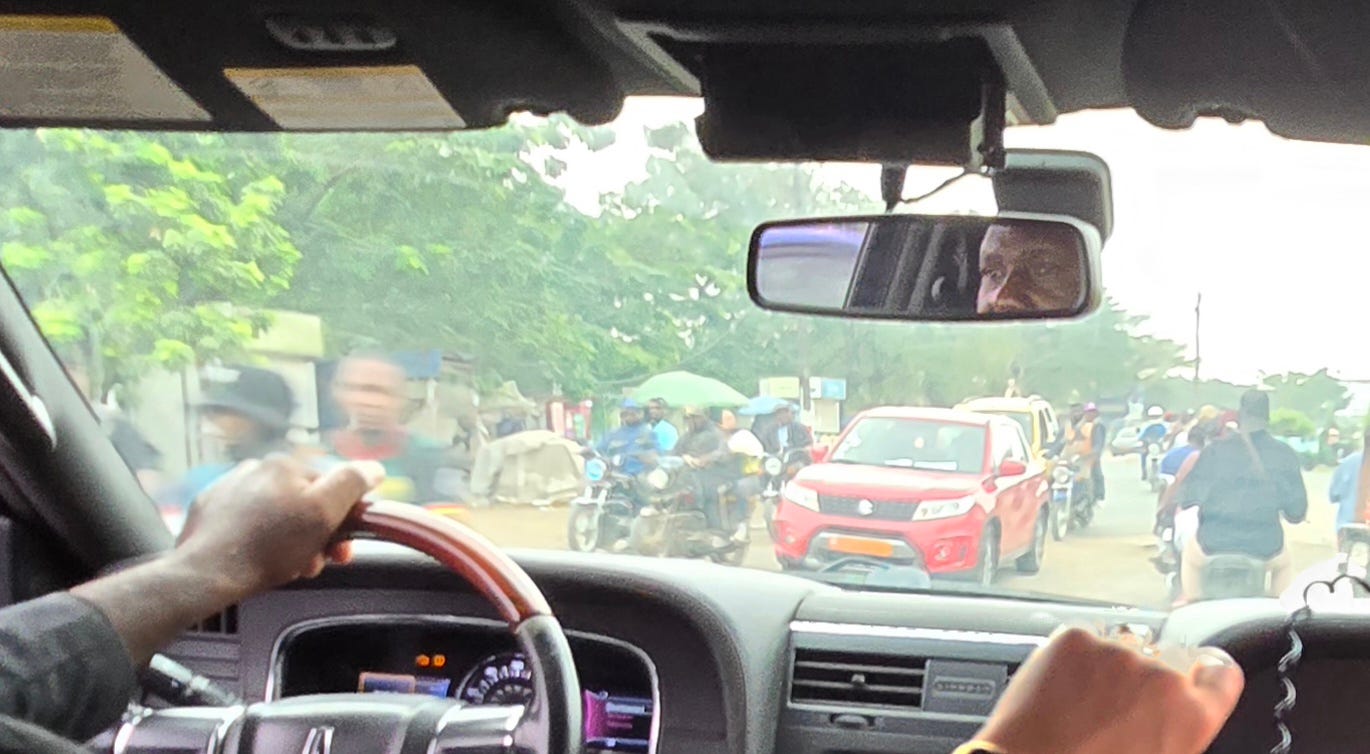
We were heading to the apartment. It was Saturday night, around 8 p.m. The roadsides were crowded. Motorcycles were everywhere, often overloaded, moving quickly through tight gaps. People filled the streets. It felt less like disorder and more like a city fully awake, people out enjoying a hot, humid evening.
I have driven in Europe and South America, in conditions that demand attention. Still, I do not think I would drive in Douala. What I saw looked like anarchy. I would have decision paralysis. Cars, motorcycles, and pedestrians shared the same space, with little visible regard for lanes, formal priority, or even direction of travel.
And the honking. Constant.
Not like Manhattan, where honking often sounds like frustration spilling outward, an extension of what is already happening inside the driver.
The next day, well rested and sitting outside, I heard it again. Unrelenting honking. Noise. Chaos, or so it seemed. But it did not take long that first week to realize it was not noise at all. It was language.
In Douala, honking communicates:
“I’m beside you,” to a motorcyclist. “Passing left,” to the car ahead. “Watch the gap,” to the truck.
A communication protocol learned through immersion, not instruction.
From outside the system, it sounds like meaningless noise. From inside, it is precise, functional, and understood.
I would not drive there. I do not know the code. You cannot learn this from instructions. No manual. No tutorial. No prompt will teach you. You have to be in it. You have to put skin in the game and learn.
With a feeling of inferiority, I would tell my driver that I had great skills driving on ice in Canada. Plenty of practice.
This is what we lose track of when we talk about AI and expertise.
The difference between know-how and how-to.
We need know-how. But we default to how-to. It is the path of least resistance to ask for instructions. The harder question is whether those instructions are actually the right path.
The False Promise
In the literacy program I am working on, before anything else, I have to put AI in context for small business owners. What can it actually do for them?
We keep hearing that ChatGPT promises to collapse the gap between novice and expert. Some people are starting to believe it.
Information scales instantly. Experience compounds slowly.
I recently heard Anthony Scilipoti on a podcast discussing how young accountants acquire expertise. For an ambitious CPA, this traditionally means years of grunt work: audits, endless questions, and long days dealing with difficult, impatient clients.
Now many assume AI will simply remove that grunt work altogether. I can almost hear the collective sigh of relief from accounting students around the world.
Scilipoti offered a warning. Those years of grunt work are not wasted time. They build pattern recognition. You develop a sense that something is off. A useful bullshit detector.
Those years are a feedback loop: mistakes, corrections, and thousands of iterations. The real value of a CPA is not rule application or tax code recall. It includes the ability to read financial statements and sense what feels right versus what feels wrong.
That judgment comes from exposure, not information.
AI can process data, perhaps faster, perhaps more thoroughly. But can it replace the judgment that forms through lived exposure?
The answer matters. Because if we are wrong, we are not just making work easier. We are quietly eroding the very thing that makes expertise valuable.
When know-how defaults to how-to, we mistake having instructions for understanding the system.
I learned this gap firsthand while working in finance in the 1990s.
My Boss and the Spreadsheet
Working in investment banking in the 1990s, I became proficient with Excel. It was a tool I relied on constantly: financial projections, discounted cash flow models, sensitivity analysis.
Need to change an inflation assumption? One entry, and the entire model updates. Sensitivity analysis? Fine. How many scenarios?
It was fast. Accurate. Powerful. In negotiations, we could test outcomes on the fly. As an associate, I mastered the tool. I ran thousands of iterations.
My boss was exceptional. Sharp, quick, deeply knowledgeable. He once told me he had learned to build discounted cash flow models using a pen, paper, and a calculator.
That sounded barbaric to me.
Change an assumption? Then you had better tell me everything up front, because I am about to sit down and redo the entire calculation by hand. No undo button. No instant recalculation.
The cost of a mistake was high. You had to think through the relationships between variables before committing anything to paper.
That friction had an unexpected benefit. It made him never take the structure for granted.
Whenever he asked me for scenarios, he would glance at my spreadsheet for maybe thirty seconds.
“Something’s off,” he would say.
My reaction: Oh shit.
He was always right.
I had not made a calculation error. The formulas were correct. The numbers reconciled. But the structure underneath did not hold. The logic was wrong.
He did not just see the numbers. He felt the structure beneath them.
Not because his Excel skills were better. They were not. He had internalized what coherent models feel like and could sense when one assumption pulled everything out of shape.
When you build projections by hand, you cannot hide from the logic. Every assumption ripples through the entire model, visibly. Over time, you develop an intuition for what holds together and what does not.
Excel amplified my analytical capacity. No question. It made me faster, more efficient, able to test scenarios that would have taken him hours.
But it could not manufacture the judgment that comes from high-cost iteration.
The tool gave me speed. Experience gave him signal detection.
This is not unique to finance or Excel. The pattern repeats whenever we confuse tool proficiency with expertise.
The Double Trap
Two things happen when we default to how-to. Both feel like efficiency. Both quietly hollow out judgment.
The first trap is the illusion of access. We think having the output means we have the expertise.
You want to start a business. You prompt AI for a business strategy. It gives you a framework that sounds sophisticated. But you have not developed the judgment to know whether it fits your specific context, your constraints, your customers.
The output looks like expertise. It is not.
The second trap is distraction from the core task. This one is more insidious.
Tools do not just offer shortcuts. They redirect attention away from the activities that build expertise.
The business owner who used to write her own email campaigns learned which subject lines got opens, which offers fell flat, which tone made people reply. Now she prompts AI for “a promotional email for my spring sale.” The output is fine. She sends it. But she is no longer in the feedback loop. The intuition that would have compounded over dozens of campaigns never forms.
This happens gradually. The tool keeps producing results. The outputs look fine. You feel productive.
But you are outsourcing the very activities that would have compounded into expertise.
You do not realize what you have lost until you need to make a call without the tool. Or the environment shifts. And you discover you can no longer read the signals yourself.
The Highway and the City
Not all tasks require lived experience. Some environments are stable enough that how-to actually works.
Changing the shock absorbers on my golf cart? I watched a YouTube tutorial, extrapolated to my model, and got it done. The task was bounded. The variables were few. The system did not push back in unpredictable ways. Instructions were enough.
Does this mean I can now call myself a “leisure vehicle ride dynamics specialist”?
Think about driver assist. On a highway, it works. Predictable environment. Clear rules.
In Douala, it would be worse than useless. The car is programmed to follow traffic rules. Douala runs on a communication protocol no AI has learned.
The difference is not complexity in the abstract. It is whether the environment is stable or shifting, whether the rules are explicit or emergent, whether mistakes are reversible or consequential.
Most valuable work does not happen on highways. It happens in complex, shifting environments where pattern recognition matters and judgment cannot be automated.
That is where defaulting to how-to leaves you exposed.
What Gets Amplified
This is not an anti-technology argument. Using Excel in the 1990s let me work on far more deals than I could have on paper. Technology can be a powerful amplifier.
But amplification cuts both ways.
A microphone amplifies your voice. It is still your voice, just louder. If you have nothing to say, it is just noise.
The question is not whether to use the tool. It is when. Tool before judgment produces dependency. Judgment before tool produces leverage.
Information scales instantly. Experience compounds slowly.
We are tempted to collapse that gap with tools. But some things cannot be shortcut.
Pattern recognition develops through exposure. Judgment forms through high-cost iteration. Signal detection requires time in the system.
The honking in Douala makes sense when you are inside the system. You cannot learn it from a manual. You cannot prompt your way into understanding it. You have to be in the traffic. You have to pay attention. You have to survive it long enough to read the signals.
That is not romanticizing difficulty. It is recognizing how complex systems actually work.
Expertise does not come from instructions. It comes from surviving reality long enough to learn from it.
The path of least resistance is to ask for instructions. In Douala, instructions will tell you how to honk. Only in the traffic will you know if you’ve learned anything.